“RED TEAM”- Challenging Gold Investments.
An article from 2011 titled “Superstitions, Myths, Folklore and Gold” and written by Michel Levy, the author of the book “Cutting Truths”, challenges some of the basic ideas behind investing in gold and silver.
“Read team” is a common term used in both business, cybersecurity and the military in order to challenge existing assumptions and practices by adopting an adversarial approach. This enables critical thinking and helps with decision-making.
We can use Michal Levy as our “red team” as he presents some of the common conceptions among investors as myths:
Fear has become the reason speculators are driven into buying gold as a safe-haven from apocalyptic disasters. This is fed by a constant stream of expert opinions, with TV anchors and other media reporting their opinions as facts. Most experts today believe in the myths of gold and predict it will continue to be a safe-haven in these uncertain times.
Perhaps they can keep the gold price rising, however, every financial instrument must have a solid foundation to make it stable and secure. Gold cannot be valued beyond the real supply and demand of industrial/jewelry usage, other than the amount of fear-driven speculative trades that causes it to rise.
Here are some of the many myths surrounding gold (and how Michael Levy busts them):
- Gold is a currency … Gold is NOT a currency nor will it ever be. Gold coins are not legal tender and you cannot go into a supermarket and buy groceries with gold dust.
- Gold holds its value in times of war … History has proven gold does not hold its value in times of war. Rather, anyone who held it became a target and was robbed and killed.
- Gold is a protection from recession… This only holds true while it goes up and for as long as the myths can continue to be fired up.
- Gold is over/under valued … This cannot be known as it is worth what people will pay for it.
- Gold is a protection from hyper-inflation… Everything goes up in hyper-inflation, that is why it is called hyper-inflation, and gold may or may not perform any better that any other commodity.
According to Michael Levy, one of the main reasons that gold has performed so well in recent years is due to the ease of trading with ETFs such as GLD.
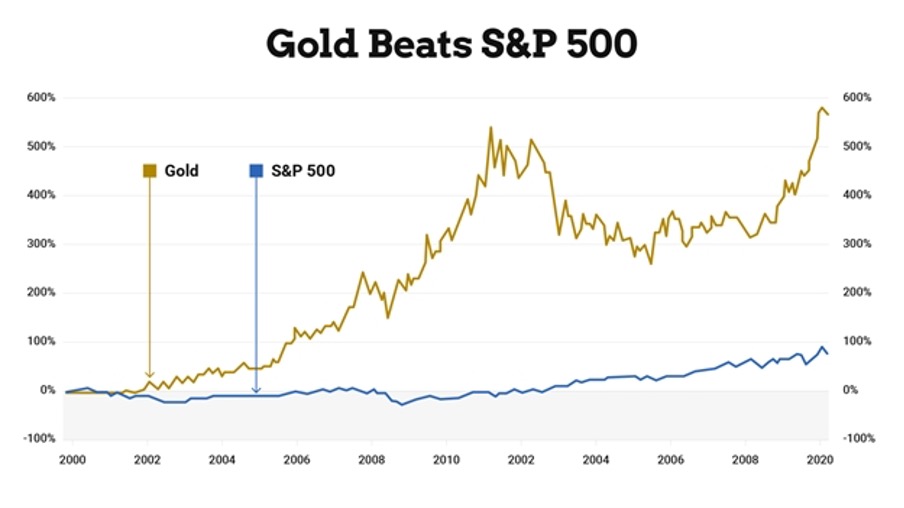
Despite all the so-called myths presented above, the graph below compares the value of investment in gold vs. S&P 500 over the past 20 years, showing that gold was indeed a good investment.
We recommend using the “red team” approach in business and investments as a tool to support decision-making.

UPDATE TO 9 OCTOBER 2025:
Gold at US $4,000/oz — Euphoria, Risk, and Vigilance
As of October 2025, gold has crossed the psychological and nominal threshold of USD 4,000 per ounce. This milestone has captured headlines, attracted new entrants, and reinforced the narrative of gold as both a “safe haven” and a must-own asset. But elevated prices and exuberant sentiment also demand that investors—and analysts—step back and reassess both upside potential and latent risks. Below I present several perspectives and cautions to consider in this new phase.
- The positive case: Why optimism is strong
Before dwelling on risks, it’s worth summarizing the arguments fueling the bullish consensus:
- Monetary policy tailwinds — In many economies, central banks continue to maintain accommodative stances, with concerns about inflation, quantitative easing reversals, and currency debasement driving demand for hard assets.
- Geopolitical and fiscal uncertainties — Global debt levels, political instability, and supply chain fragilities bolster risk-hedge demand.
- Momentum and FOMO — As gold passes symbolic price levels, retail and institutional momentum can self-reinforce further inflows.
- Limited supply elasticity — Mining output, recycling rates, and geological constraints limit the speed at which supply can respond to surging demand.
- Diversification appeal — In a world of low real yields, equity and bond volatility, gold retains a place as non-correlated ballast.
These forces underpin why many see gold not just as a defensive asset but as an asymmetrical upside bet at these levels.
- The risk side: Where optimism meets caution
However, with elevated valuations come heightened sensitivities. Below are some of the key risks and countervailing views that any “Red Team” or skeptical investor ought to stress-test.
Risk Factor | Explanation | Possible Mitigation / What to Watch |
Valuation shock / mean reversion | At very high levels, the margin for error is thinner. A sudden shift in interest rates, dollar strength, or sentiment reversal could trigger rapid downside. | Use trailing stops, take profits on partial positions; monitor interest rate announcements and central bank communications. |
Real interest rate risk | If real interest rates (i.e. yields minus inflation) rise strongly, gold’s opportunity cost increases and bullion becomes less attractive. | Watch bond markets, inflation expectations (breakevens), and shifts in real rates globally. |
Currency strength / dollar rebound | Gold is often inversely correlated to the U.S. dollar. A strong dollar rally (perhaps driven by safe-haven demand or capital flows) could weigh on gold in USD terms. | Monitor dollar indices (e.g. DXY), carry trade flows, and foreign exchange risk hedges. |
Liquidity & flows reversal | ETF and paper gold flows might exhibit higher volatility at high prices. If sentiment shifts, redemptions could trigger forced selling. | Observe net flows in key gold ETFs and futures positioning (e.g. CFTC data). |
Regulatory, tax, or policy risk | Governments might respond to extreme asset bubbles with new taxes, stricter reporting, or other constraints. | Stay alert to policy discussions, especially in major markets (US, China, EU). |
Physical vs. paper mismatch | In times of stress, premiums for physical delivery, storage bottlenecks, or counterparty risk (in leased gold, vault operations) may emerge. | Prefer allocating a portion to allocated, fully backed physical gold; understand custodial arrangements. |
Overcrowding and sentiment complacency | When “everybody” is bullish, downside surprises are less tolerated. The market may be less forgiving of negative surprise. | Include contrarian indicators and monitor sentiment extremes (surveys, options skew, news headlines). |
Diminishing marginal returns | At ultra-high levels, further upside may be harder to achieve without broader macro catalysts. | Reassess entry points and consider alternative non-precious metal diversifiers. |
- Listening to differing voices
To enrich the analysis and guard against groupthink, it may help to weigh voices from contrasting camps:
- The permabull: sees $4,000 as just the beginning in a secular bull market driven by monetary debasement and wealth transfer.
- The macro skeptic: warns that central banks have less room to maneuver, and that bubbles (e.g. in equities, cryptocurrencies) may unwind concurrently, leaving gold vulnerable.
- The market technician / quant: will study momentum indicators, volume anomalies, overbought signals, and long/short positioning to infer short-term reversion risk.
- The crisis hedge pragmatist: views gold as insurance first, speculative second. Their stance is: “If gold falls, it falls — but I don’t want to regret under-allocating when it climbs.”
- The policy hawk / inflation hawk: may argue that interest rate hikes, inflation control or currency defense may impose headwinds to gold even in a stressed macro environment.
In your revised chapter you could include short quotations or viewpoints (e.g. from recent interviews or financial commentators) to anchor the discussion in real voices.
- Suggested structure and tone
- Opening anecdote or snapshot — e.g. “On October 3, 2025, gold touched $4,020, prompting exuberant headlines…”
- Balanced narrative — open with why the excitement is justified, then methodically walk through risks (as above), finally emphasizing cautious optimism.
- “Red Team” challenge box — insert a side box titled “What if we’re wrong?” with bullet risks.
- Call to action / checklist — e.g. 5 questions an investor should ask before adding gold now.
- Data & visual support — updated charts: gold price vs real rates, ETF flows, net positioning, dollar index, premiums for physical gold, etc.
- Conclusion with humility — “Gold at $4,000 may still have room to run — but the higher it climbs, the more respect it deserves from the skeptic’s lens.”